
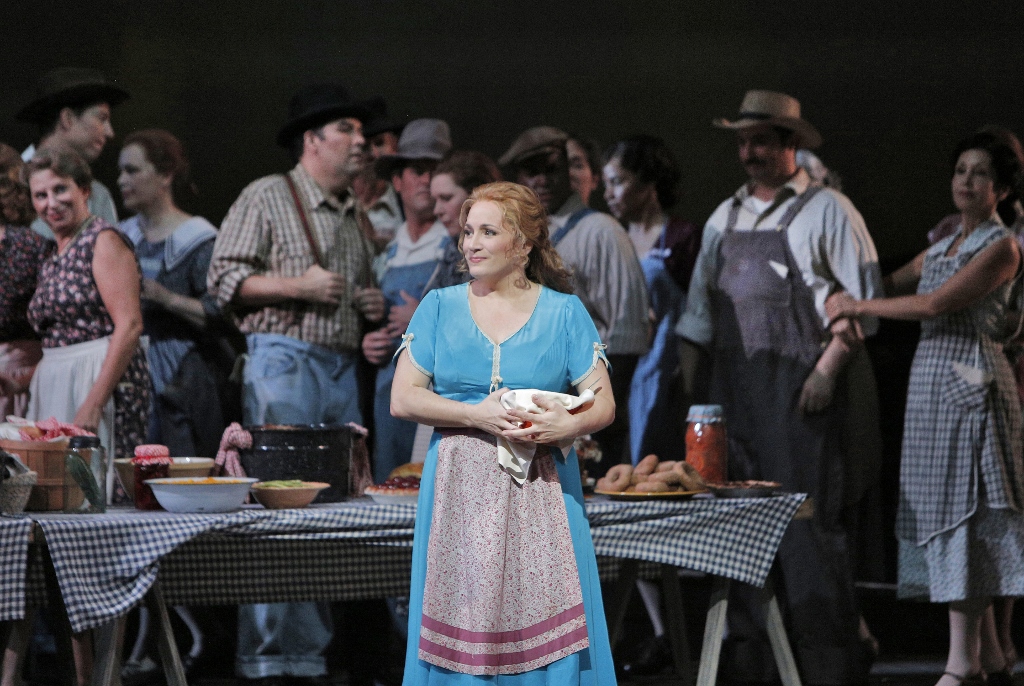
Susannah | From the Director
Carlisle Floyd's Susannah sits close to my heart: it draws me to my identity as an American, as a woman, as a member of society at large, as a singer (when I was only 20 years old, it was the very first operatic role I ever performed!), and now it extends its pull on me as a director.
Rediscovering this story (loosely based on the Apocryphal account of "Susanna and the Elders" from the Book of Daniel) inspired me in terms of not just its relevance of depicting a community buried in dogma, narrow-mindedness, and intolerance but also, because of the connection between the tale’s truth and the role of the tree. In the Biblical account, the unabashed lust and unjust threats from the Elders incriminate them when their lies about the details of the false accusation are untangled – each claiming that Susanna’s "crime" took place under a tree – but each describing a different kind of tree, thus revealing their lie. While Susanna is vindicated in the Biblical account, the operatic heroine’s treatment is not so redemptive. Floyd’s Susannah Polk dares to be different, dares to think independently, and dares to conceive of a life outside the city limits — in all senses of the expression. My hope is not only to deliver the narrative of this opera but also to underline the consequences of intolerance and dogmatic thinking that are so often prevalent in our society. The dangers of groupthink are real indeed…it frequently feels as though individualized thinking is less valued than ever before.
Floyd’s score indicates the place and the time period: New Hope Valley, Tennessee – The Present. Given this directive license, we have opted to tell this story through the lens of a 1990s New Hope Valley. The omnipresent tree anchors our visual space but is enveloped by the girding backdrop of the Appalachian Mountains, giving us the promise of another sunrise, another season. Incorporating the use of projections allows for a broader palate of visual possibilities so that we can shift more seamlessly between scenes and locales.
Appalachia itself becomes a double-edged sword, as the natural beauty of its edges also serves to suppress, illuminating the sway held by conformity, or more importantly, the fate that can await those who dare to break free.
Religion is a fulcrum in the action of this story that unfolds over the course of one week, proving its conflicting power to both unify and ostracize, to lift up yet subsequently quash those who dare to defy its tenets. When those who pray together then also prey together, the ugliness of mass mentality rears its head, forever devastating the life of a young woman whose innocence became an immutable casualty.
-Patricia Racette
photo credit: Susannah, San Francisco Opera, 2014