
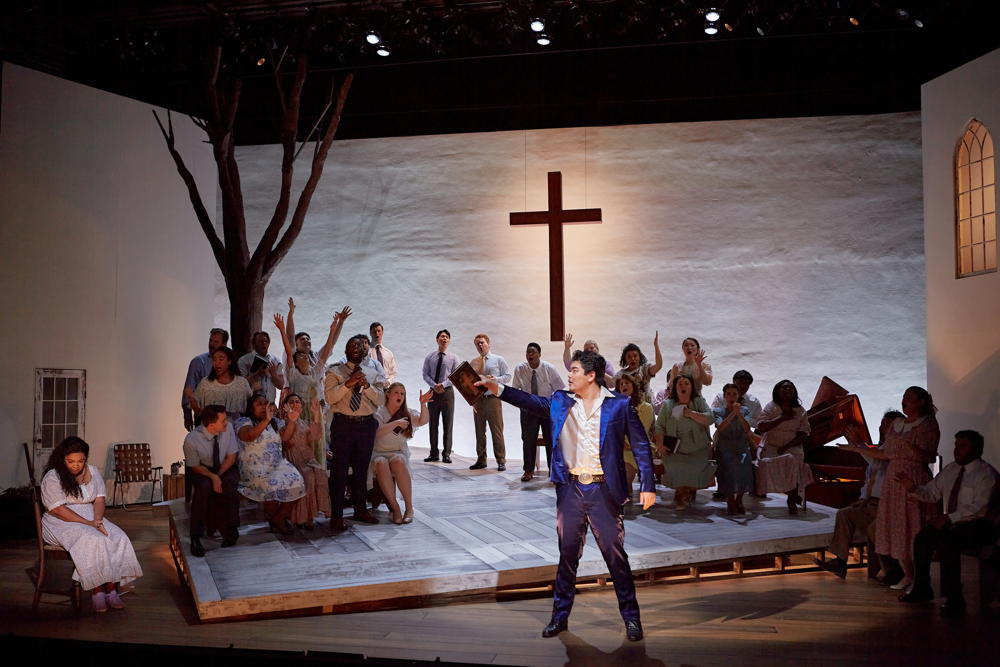
From the Conductor: Personal Reflections on Carlisle Floyd and Susannah
As we celebrate the 100th birthday of Carlisle Floyd, we join the ranks of his innumerable admirers in recognizing his singular stature as the Dean of American Opera. With his death in 2021 at age 95, Floyd left not only a legacy, but also a standard by which modern American opera can justly be assessed. His compositional procedure emphasized the pre-eminence of textual prosody—the music of the text. There’s a reason why his characters seem comfortable in their operatic skin: their creator has vanquished from their stage-language any pretense or stylized contrivance that would interfere with their unalloyed naturalness.
Despite a lifetime of steady operatic output that included such operas as Wuthering Heights, Of Mice and Men, Cold Sassy Tree and others, it is notable that Susannah remains Floyd’s most well-known and beloved opera. Consider the fact that Floyd was only 28 when he composed Susannah (music and libretto). Mozart was 30 when he wrote Le nozze di Figaro, with four operatic masterpieces yet to come!
As I’ve approached this opportunity to conduct Susannah again, I’ve been reflecting on several personal connections to the composer and the opera that have resonated meaningfully with me over the years. I am a native South Carolinian, just like Carlisle Floyd. Both of us were born into a common culture in which sincere and fervent fundamental Protestantism was the religious ambiance of our everyday existence. As children and young men, our lives and worldviews were informed by examples both of genuine goodness and also debilitating hypocrisy and judgementalism that could often lead to destruction and squalor.
My late father was the first member of his family ever to finish high school. His roots were in the mountains and hills of Appalachia—southwest Virginia, to be specific. I spent every summer of my childhood in this wondrous environment. It was there that I first fell in love with authentic Appalachian folk music, my grandmother having so often sung me to sleep with “Barbara Allen” and other Scotch-Irish ballads that are the core source of the American folk-song canon. Now it’s important to understand that, while Susannah is sometimes called a “folk-opera,” Floyd himself preferred “folk-like” in describing the music. “The Trees on the Mountain,” the “Jaybird Song,” and all the opera’s other manifestations of folk-like music are entirely original with Floyd. I find this uncanny verisimilitude jaw-dropping in its effectiveness and infinitely endearing in its sentimental poignancy.
There are so many other aspects of Susannah that strike personal chords with me. One of my family’s 19th-century ancestors was a circuit-riding evangelist who would go by horseback from one rural community to the next, conducting revivals and challenging each community to commit themselves to righteousness. I like to think that’s where the parallel with the opera’s Olin Blitch ends. But the hymnody that Floyd uses to color the church scenes in the opera’s New Hope Valley locale is strikingly accurate and authentic, both in music and text—all while being newly composed. It represents the style of hymn singing that I, myself, encountered and led in my first ever paid musical job as music director of New Hope Church in a rural north Georgia mountain community.
Finally, I’d like to mention an experience I had years ago when my wife (soprano Elizabeth Futral) and I were recording “Ain’t it a Pretty Night” in London with the Philharmonia Orchestra, as part of Chandos' "Opera in English" project. While Susannah has become familiar to American audiences over the years, for the members of the Philharmonia Orchestra it was a new encounter. They were overwhelmed and in awe of this great music—its sense of space, atmosphere and personal connection to Susannah herself. The concertmaster asked me, “this Carlisle Floyd, he must be your country’s greatest opera composer?” I answered, “Yes—perhaps he is.”