
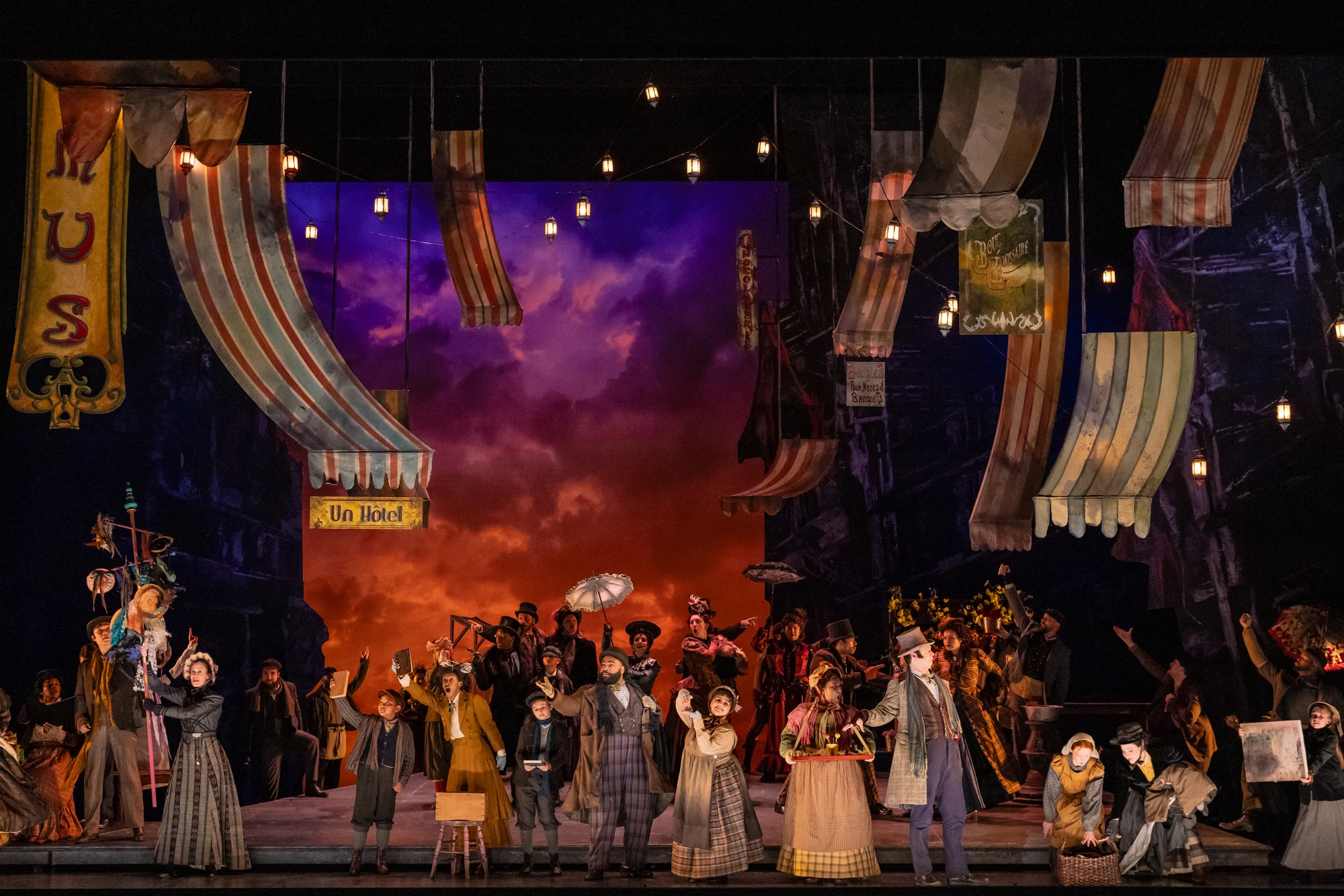
It is a joy to return to this production of La bohème, originally created for The Glimmerglass Festival in 2016. The production has since traveled with me to OPERA San Antonio and back to Glimmerglass. Nearly a decade after we first imagined it, I am delighted to introduce this very special Bohème to Opera Omaha.
When we began designing the production, we wanted to place these characters in the vibrant world of Belle Époque Paris; a city alive with painters, poets, performers, cafés, cabarets, and people living just outside the boundaries of respectable society. Toulouse-Lautrec and the nightlife he captured became important visual touchstones for us. This is a world filled with color and personality, but also one in which poverty is never far away.
That combination seemed perfect for Puccini’s bohemians. Our goal was to never have the production design Rodolfo, Marcello, Schaunard, and Colline are struggling artists, but what defines them is their charisma, their humor, their ambition, and their extraordinary friendship. They have chosen to live with almost nothing, yet at the beginning of the opera their world feels enormous. A manuscript can become firewood. A meager meal can become a feast. An empty room can be filled with laughter. They possess the optimism of youth – the belief that somehow everything will work out.
Mimì enters that world from somewhere very different. She is young, reserved, and working to support herself as a seamstress. As she falls in love with Rodolfo, she is also drawn into the freedom and unconventionality of his circle. Musetta, by contrast, seems born to inhabit this Paris: theatrical, independent, sensual, and completely aware of the effect she has on everyone around her. These women are very different, but neither is merely an accessory to the men who love them. They bring their own desires, choices, contradictions, and vitality into the story.
With this in mind, the creative team deliberately chose a sparse scenic vocabulary for the production. Rather than recreate Paris compete with the brilliance of simple human moments. The purpose of the environment is to naturalistically, a few pieces of architecture, furniture, light, and the ever-present Parisian sky suggest the world around the characters. Objects transform and spaces are reconfigured before our eyes. What matters is not the completeness of the room, the café, or the city gate, but what happens between the people in these spaces.
And as their story changes, so does their world. The expansive promise of the opening gradually disappears. By Act 3, winter has arrived, relationships are fracturing, and the characters have reached an emotional low point. The architecture itself begins to feel more exposed and broken apart. When we return to the garret in Act 4, there is even less than there was at the beginning. What once seemed playfully impoverished now feels genuinely empty. The friends can still joke and pretend, but we understand that youth cannot protect them from everything.
That is one of the things I find so devastating about La bohème. Puccini does not tell us the story of extraordinary people. He gives us ordinary moments and allows us to discover how extraordinary they become because they will not last. give these young people a world in which to live— and then allow Puccini, and the artists performing his opera, to do the rest.
Every time I return to La bohème, the production feels new because the people inside it are new. Each Rodolfo and Mimì find their own way toward one another. Each Marcello and Musetta discover their own wonderfully impossible relationship. And each group of bohemians creates the sense that, for one fleeting period of their lives, these friends truly are a family.
Perhaps that is why we continue to return to La bohème. Most of us know something about a time when our friends were our world, when the future seemed impossibly large, and when we did not yet understand how quickly those days would pass.
It is a delight to return to this production once again, and a privilege to share it with Omaha.
— E. Loren Meeker